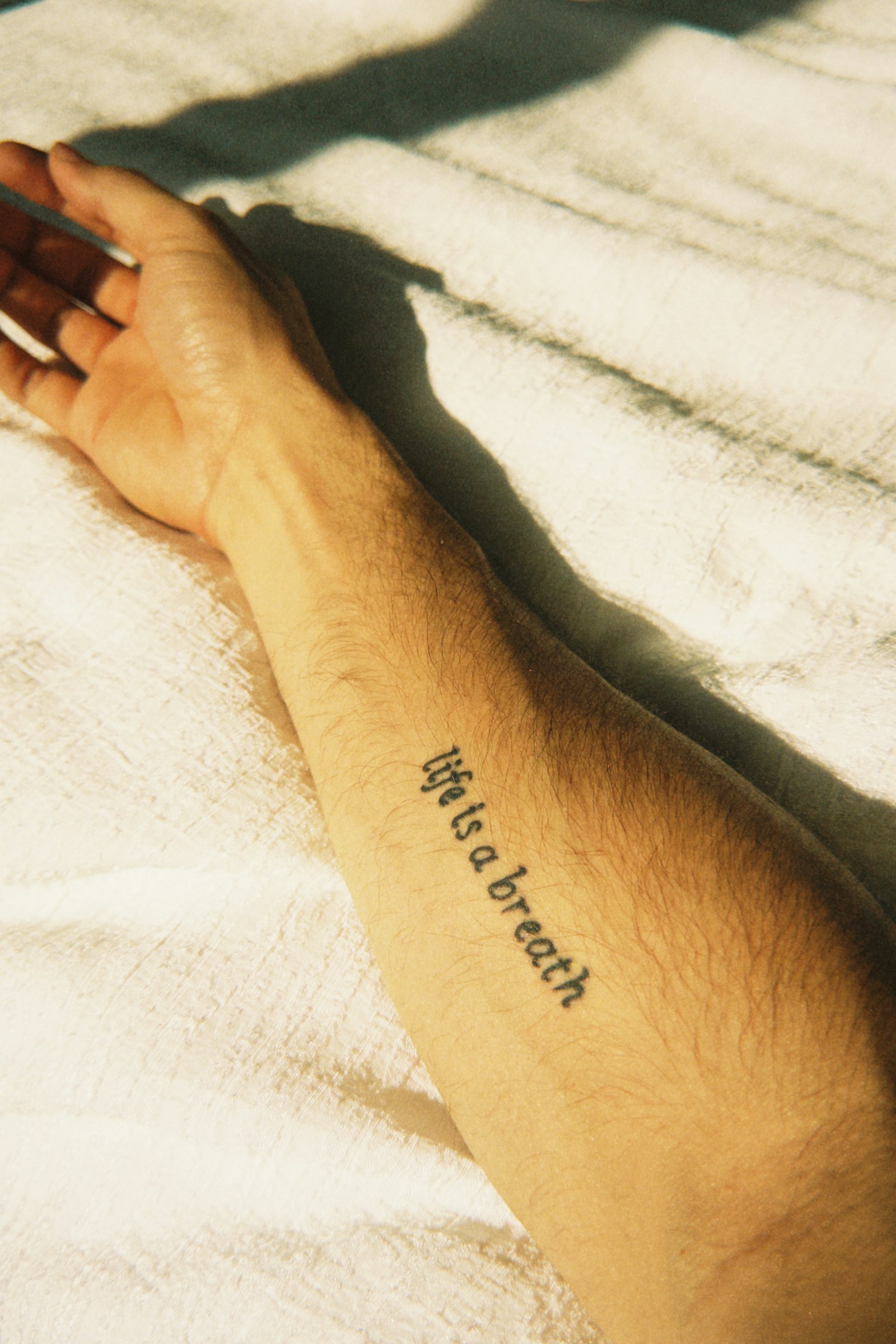
Before any line is drawn, the body has already drawn something.
There are the obvious lines, the bone-structures the eye knows: the inside of the forearm, the curve of the collarbone, the small hollow above the hip. There are the less obvious ones: the shape a freckle makes with the two freckles next to it, the silvered seam of an old scar, the way a vein lifts at the inner elbow when the arm bends. Every body comes pre-composed. The artist is not starting on a blank page. The artist is collaborating with whatever is already there.
This is, increasingly, the working philosophy of the world's most thoughtful fine-line artists. Brian Woo, the Los Angeles tattooer known professionally as Dr. Woo, talks about the way single-needle fine-line work is "particularly suited" to the contours of the body because the lines themselves are so thin that the skin's own architecture becomes part of the image (My Modern Met, "Geometric Fine Line Tattoos by LA's Famous Dr. Woo"). His designs, often geometric, often celestial, are placed almost surgically with the underlying anatomy in mind: a constellation that follows the run of the forearm tendons, a circle that sits exactly inside the dish of the inner wrist.
A different lineage of the same instinct comes from the watercolour tattoo movement most associated with the artist Sasha Unisex, the Saint Petersburg-trained tattooer whose work, particularly in the years between 2012 and 2017, ignored the dominant convention of bold black outlines almost entirely. She favoured soft watercolour washes that bled into the natural pinks and yellows of skin tone (Bored Panda, "Sasha Unisex"). The effect was a tattoo that did not look applied. It looked grown.
Both lineages — Dr. Woo's geometric minimalism and Sasha Unisex's dissolved colour — share a single conviction. The body is not a wall to mount an image on. It is a substrate. Every substrate has its own grain, and good art works with the grain.
II. The Same Design, Different Sentences
A wave on the inside of the wrist is a different sentence from a wave on the ribcage.
The wrist wave is read at the speed of a glance. It belongs to the language of small jewellery: a ring, a thin watch, a charm. It declares itself in passing. Someone hands you a coffee, you reach for it, and the wave appears. Then it is gone.
The same wave on the ribcage is slow. It belongs to the language of intimacy. It will only be seen when a shirt rides up, when an arm is raised, when someone who has earned closeness gets close. Same line, same proportion, same artist. Different sentence.
Designers and tattooers have a phrase for this: "placement is half the design." The fine-line community has, in the last decade, formalised it almost into a rule. A piece is briefed twice: once for the image and once for where the image will live. A piece that ignores its placement reads as a sticker. A piece that respects it reads as a feature.
The body's natural topography does this work for you, if you let it. The clavicle is a horizontal line; designs that run along it (a short stem, a single word, a bird mid-flight) feel architecturally settled. The forearm is a long vertical; designs that climb it (a stem, a column of script, a narrative thread) feel like they belong. The space behind the ear is a pocket; tiny pieces tucked there feel like secrets because the geometry of the location is already a secret.
III. Designing With the Body, Not on It
The most common mistake of a first tattoo is to design it without the body in the room.
You sketch the image on a piece of paper. The artist redraws it cleanly. You agree on a size. Only at the end, with the stencil already cut, do you stand in front of a mirror and start asking the body where it wants to go. By that point, the body is being asked to host an image it had no part in designing. The image will sit on the skin, but it will not sit with the skin.
Working the other way around is slower and better. Stand in front of the mirror first. Look at the actual map you have: the freckle on the left collarbone that nobody else has, the small scar from a childhood fall on the inside of the elbow, the place where a vein lifts when the wrist bends. Decide on the placement before the image. Let the empty page suggest the line, the way a sculptor lets the stone suggest the figure.
This is not mysticism. It is composition. A good piece does not feel applied; it feels found.
IV. The Canvas Is Alive
The deepest reason to think of the body as canvas, rather than as a surface, is that the body is moving.
A canvas in a frame is finished. It will look the same tomorrow as it does tonight. Skin will not. Skin tans, pales, stretches, settles, scars over, freckles in summer, smooths out in winter, holds the print of your sleep crease in the morning, recovers by lunch. A tattoo applied to skin is, from the moment it is applied, in conversation with a moving partner.
Permanent ink pretends this is not happening. It locks the design in place and lets the partner change underneath it, often with results that look, twenty years later, like an argument neither side won.
Semi-permanent ink admits the partnership openly. The piece is here for as long as the conversation is interesting, and then the skin renews itself and the next conversation can begin. The fact that the design fades is not a contradiction of the canvas-as-living idea. It is a confirmation of it. A living canvas does not host a permanent image well, because nothing about a living canvas is permanent.
The body draws first. The artist listens. The tattoo joins the composition, briefly, and then the composition continues without it.
This is the most generous thing you can do for a body: agree to wear it lightly.