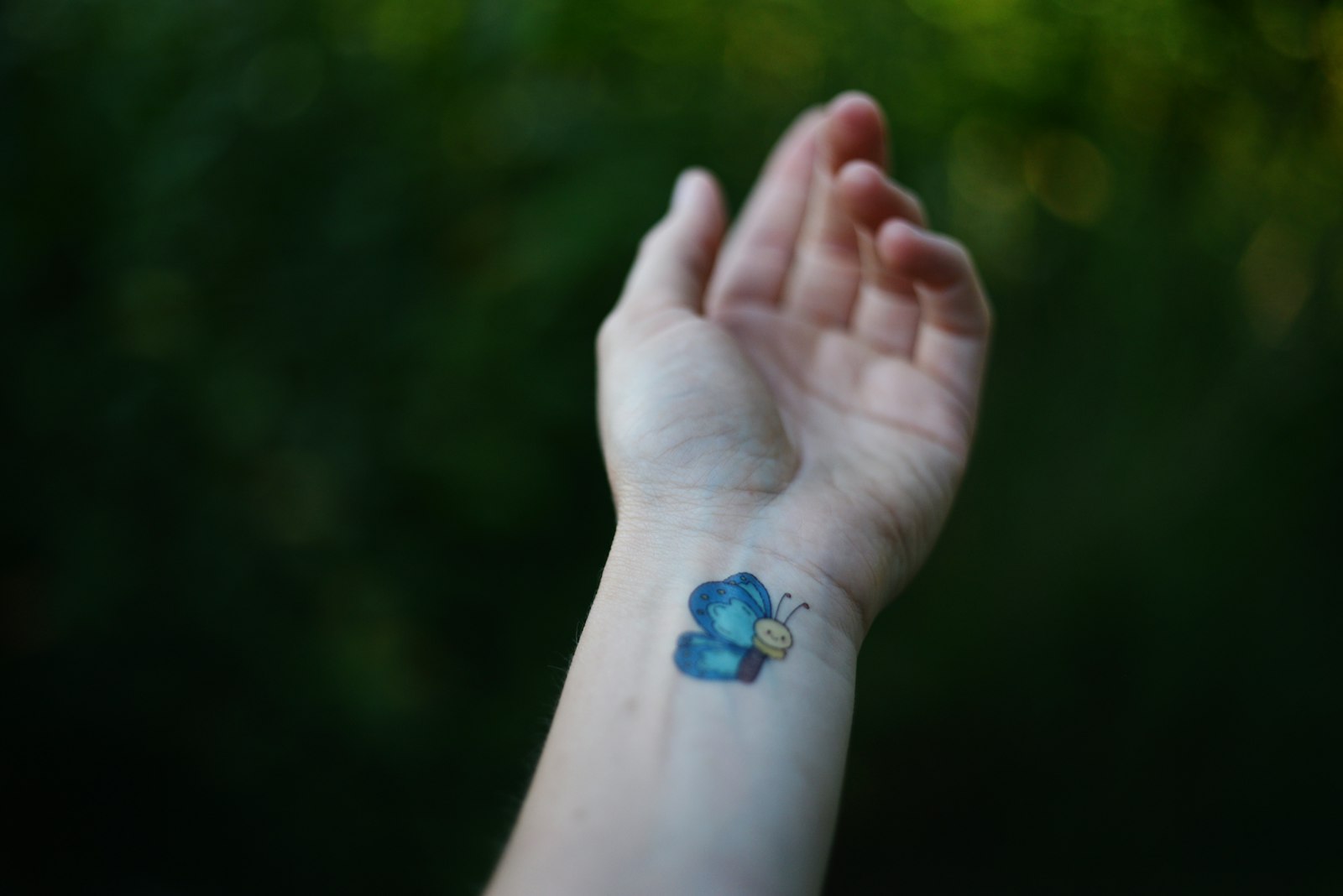
The traditional argument for a tattoo goes something like this: it is a vow you make to a future version of yourself. You choose a symbol, a sentence, a saint, and you press it into your skin so deeply that, in theory, neither time nor regret can separate you from it. The argument is romantic. It is also slightly absurd.
Because the version of you that signed that vow at twenty-two does not live here anymore. She moved out. She grew her hair, then cut it, then grew it again. She fell in love with three cities and out of love with one of them. She changed her job, her diet, her politics, her shampoo. The tattoo, meanwhile, stayed exactly where she left it. The most permanent thing about a permanent tattoo is not the image. It is the era it preserves: a perfect fossil of who you were on a Tuesday afternoon in 2014.
Sabai Ink starts from a different premise. We make semi-permanent fine-line tattoos that fade naturally, usually within a season or two. We do not consider this a compromise, a training tattoo, or a starter version of "the real thing." We consider it the more honest object. A tattoo that fades does not pretend you will be the same person forever. It simply agrees to be on your skin while you are this person, and to leave gracefully when you are not.
That is not less serious than commitment. It is a different kind of seriousness.
The Wardrobe We Never Questioned
Look at how the rest of your life already accepts impermanence as a virtue. The capsule wardrobe is built around the idea that fewer, better, rotated pieces serve a person more honestly than a closet of vows. Pew Research Center reported in 2023 that 32 percent of U.S. adults have at least one tattoo and around a quarter of those tattooed regret one of them, a number that suggests the closet logic might be overdue at the skin level (Pew Research Center, "32% of Americans have a tattoo," August 2023).
Perfumers know that a person wears different scents in different seasons, that a leather oud in February is not the same proposal as a green fig in July. Journals are kept and abandoned and started again. Apartments are decorated, redecorated, lived in, left. We do not consider a candle that burns down a failure of candle-making.
We have made our peace with impermanence almost everywhere. Almost. The one place we have insisted on the eternal is the one place that ages most visibly: the body itself. The skin you tattooed at nineteen is, by your thirties, a different organ. It has migrated, slackened, freckled, scarred, and rewritten its own story. Permanent ink is the only thing in the equation pretending nothing has changed.
Reframing Permanence
The deepest objection to semi-permanent tattoos is usually phrased like this: "If it isn't forever, what's the point?" That question has a hidden assumption. It assumes meaning is a function of duration. That a marriage of forty years is more meaningful than a year of being completely in love at twenty-six. That a song you have known your whole life means more than the one you cried to last August.
You already know this is not true. You know that a sunset matters precisely because it does not stay. You know that the cherry blossoms in Ueno Park draw crowds not despite the fact that they last about a week, but because of it. The Japanese have a phrase for this: mono no aware, the gentle awareness of the impermanence of things, articulated by the eighteenth-century scholar Motoori Norinaga in his commentary on The Tale of Genji (Stanford Encyclopedia of Philosophy, "Japanese Aesthetics").
It is not sadness. It is attention.
A semi-permanent tattoo is mono no aware on skin. It asks you to wear something for as long as it wants to be worn, and then to let it go. It pays attention.
What Fine-Line Actually Means
There is a small but stubborn prejudice that "fine-line" means "tentative." That the thin black hairline of a wave on a wrist is the timid cousin of a heavy traditional dragon. This is a misreading.
Fine-line tattooing was crystallised in Los Angeles in part by the artist known as Dr. Woo, who trained at Shamrock Social Club under Mark Mahoney and made the single-needle aesthetic globally fluent through Instagram (Fashionista, "How Dr. Woo Set the Bar for a Generation of Tattoo Artists," August 2018). Single-needle work is, technically, harder. There is no shading to hide a wobble. Every line is the line. A precise tattoo is not a less serious tattoo. It is, often, a more serious one. It just happens to whisper.
Sabai's aesthetic is built in that whisper. Hair-thin botanicals, geometry that respects the bone underneath, a sentence in your own handwriting on the inner forearm. Designed to be read up close, by you, in a mirror, in the morning. Designed not to dominate a body but to keep it company.
The Brand Promise, In Plain English
Wear it now. Let it go later. Wear something else next month.
That is the entire argument. We are not asking you to believe less in self-expression. We are asking you to believe more in the self that is doing the expressing, which is a moving thing, a verb, never a finished sentence. The most confident thing you can wear on your skin is something that admits you are still becoming.
Most permanent tattoos are an answer. A Sabai tattoo is a question, asked again every time it fades and you choose what to wear next. We do not think this makes the choice smaller. We think it makes it constant.