There is a way of explaining a fading tattoo that sounds defensive, and there is a way that sounds true. The defensive version says: it is not really a tattoo, but it is almost as good. The true version is harder, slower, and more interesting. It says: the fading is not a flaw of the product. The fading is the point.
This essay is for the second version. To get there, we have to leave the tattoo studio for a while and walk through three ideas that have been thinking about impermanence for a thousand years longer than we have.
I. Wabi-Sabi: The Beauty of the Incomplete
In 1994, the writer Leonard Koren published a small book called Wabi-Sabi for Artists, Designers, Poets and Philosophers. It became, slowly and then suddenly, the standard English-language reference for an aesthetic concept that resisted English-language translation. Koren defined wabi-sabi as "a beauty of things imperfect, impermanent, and incomplete… a beauty of things modest and humble… a beauty of things unconventional" (Koren, Wabi-Sabi for Artists, Designers, Poets and Philosophers, Stone Bridge Press, 1994).
Wabi-sabi sees the chip in the ceramic bowl, the silvering of weathered cedar, the asymmetry of a hand-thrown cup, and reads them not as failures of finish but as evidence of a real life. Things that have been used, that have weathered, that have nearly broken and didn't, are more beautiful than things that have been protected from time. Time is not the enemy of the object. Time is the second author of the object.
Apply this to skin. A semi-permanent tattoo, by design, will lighten. Its lines will soften. Its edges will get a little less certain over the weeks. In a permanent-tattoo grammar, this is bad: the tattoo is "fading," which sounds like "failing." In a wabi-sabi grammar, the same thing reads as the tattoo doing its job. It is becoming the kind of mark you can love because it is not pretending to be untouched.
II. Mono No Aware: The Tenderness of Passing
The eighteenth-century scholar Motoori Norinaga, working through The Tale of Genji, named a feeling that was already old in Japan but had never been crystallised into a single phrase: mono no aware. Literally, "the pathos of things." More usefully translated as the gentle, bittersweet awareness of impermanence (Stanford Encyclopedia of Philosophy, "Japanese Aesthetics").
Mono no aware is what you feel at the end of a long, good day, when you can already tell you will miss it. It is what you feel under the cherry blossoms, which the country every year mobilises to watch precisely because they will be gone in a week. It is not sadness, and it is not nostalgia. It is the doubled attention you give to a thing because it is leaving.
You do not get this feeling from things that promise to last forever. You cannot feel mono no aware about a marble statue. You can only feel it about a moment, or a season, or a face that is changing in front of you.
A fading tattoo invites this kind of attention. You wear it knowing the date is unstamped but real. You catch yourself looking at it more carefully in the third week, in the second month, when it is starting to soften. The tattoo trains you to notice the version of yourself that is wearing it, because that version too is leaving.
III. Anicca: The Buddha's First Observation
The most fundamental of these ideas predates wabi-sabi and mono no aware by more than two thousand years. In Buddhist teaching, anicca is one of the three marks of existence, alongside dukkha (unsatisfactoriness) and anatta (non-self). The Encyclopaedia Britannica summarises it cleanly: "anicca, in Buddhism, the doctrine of impermanence… that the human body is subject to change is empirically observable in the universal states of childhood, youth, maturity, and old age. Similarly, mental events come into being and dissolve" (Britannica, "Anicca").
Anicca is not an opinion. It is a description. Everything you have, including the body holding this magazine, is in the process of becoming something else. Recognising that is, in the Buddhist account, one of the first steps toward not suffering about it.
The doctrine is not pessimistic. It is more like a weather report. If you accept that things change, you stop being surprised by change. You stop trying to nail down a self that was never going to stay still anyway. You stop confusing the snapshot for the person.
A permanent tattoo is, in a small way, an argument against anicca. It says: this image, at least, will not change. Anicca smiles politely and points out that the skin holding the image will change, and the person inside the skin will change, and even the ink itself, given enough decades, will migrate. Permanence is a story we tell. Impermanence is what is actually happening.
IV. The Sand Mandala: Art That Knows It Will Be Swept
You can read about anicca, or you can watch it.
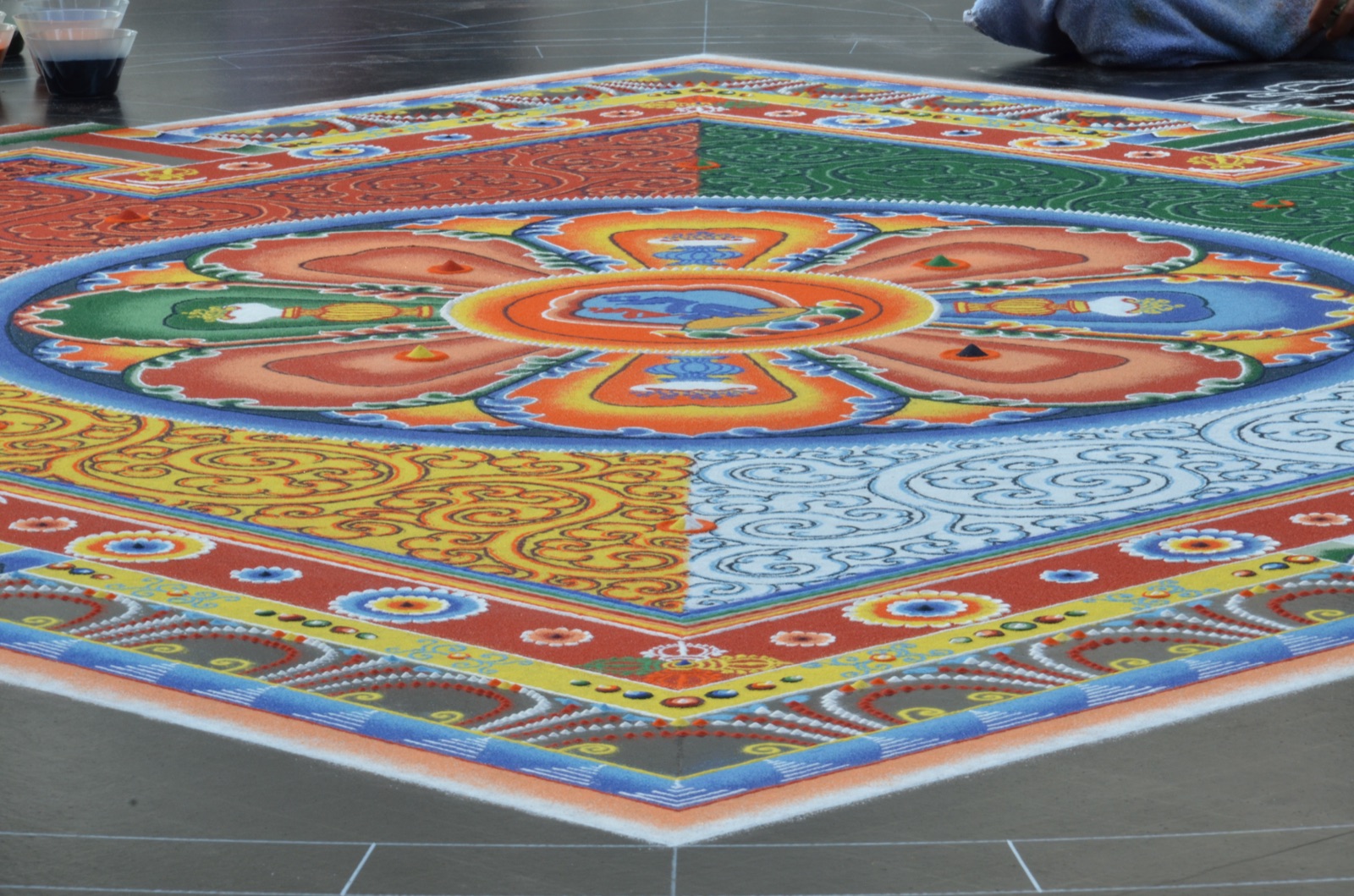
In Tibetan Buddhist practice, a team of monks will spend days, sometimes weeks, building a sand mandala. They use a tool called a chak-pur, a small ridged metal funnel that, when scraped, vibrates grains of coloured sand into intricate concentric patterns. The Kalachakra Mandala, one of the most complex, contains the depictions of more than seven hundred deities (Wikipedia, "Sand mandala," and Minneapolis Institute of Art, "The Tibetan Sand Mandala: A Short History").
Then, having made it, the monks destroy it.
The dissolution ceremony is deliberate. A senior monk draws lines through the mandala with a vajra or a finger. The other monks join. The sand is gathered and poured into a body of moving water, "to disperse the healing energies of the mandala to sentient beings in water and throughout the world" (Wikipedia, "Sand mandala"). The destruction is not a regrettable necessity; it is the second half of the artwork. The Minneapolis Institute of Art describes the dissolution as a sweeping that "represents the impermanence of everything in the universe."
Imagine spending a month on a tattoo and, by design, sweeping it away. Most people, faced with that suggestion, recoil. But everyone reading this is already subject to the deeper version: the body itself is the sand mandala. The monks just have the courage to do, deliberately, what time will do anyway.
V. The Lesson, Applied
A semi-permanent tattoo is not dying. It is completing its arc.
That distinction matters. "Dying" implies the tattoo's life was supposed to be longer, and that fading is a kind of failure. "Completing its arc" implies the lifespan was the design. The piece existed for the months it was meant to exist; you wore it for those months; it is now leaving, on schedule, and the skin underneath is ready to host whatever comes next.
What comes next is, importantly, your decision. This is the choice point that no permanent tattoo offers you. When the design has faded, you can:
- Refresh it, identically. Keep it as your anchor. Some clients have worn the same small piece for years, watching it lighten and re-darken in cycles, the way you might re-wax a wooden table.
- Refresh it, evolved. Change the colour, the angle, the size. Keep the spirit, change the sentence.
- Move on entirely. Let that piece of skin go quiet. Put something completely different somewhere completely different.
- Let your skin be skin. Wear nothing for a while.
Each of these is a real choice. None of them is a cleanup of a mistake. The fading is what makes the choice possible at all. A permanent tattoo gave you one decision and asked you to live inside it. A fading tattoo gives you that decision again and again.
If wabi-sabi teaches you to love the imperfect, mono no aware teaches you to notice the leaving, and anicca teaches you to expect the change, then the sand mandala teaches you to participate in the change willingly. The fading tattoo is in that lineage. It is small, and it is on your skin, but it is asking the same old question that monks have been asking with coloured sand for centuries: can you make something beautiful, knowing it will not stay?
If your answer is yes, you already understand what we make.
Sources & References
- Leonard Koren, Wabi-Sabi for Artists, Designers, Poets and Philosophers (Berkeley: Stone Bridge Press, 1994).
- Stanford Encyclopedia of Philosophy, "Japanese Aesthetics," entry by Graham Parkes and Adam Loughnane. Source
- "Anicca," Encyclopaedia Britannica. Source
- "Sand mandala," Wikipedia. Source
- Minneapolis Institute of Art, "The Tibetan Sand Mandala: A Short History." Source