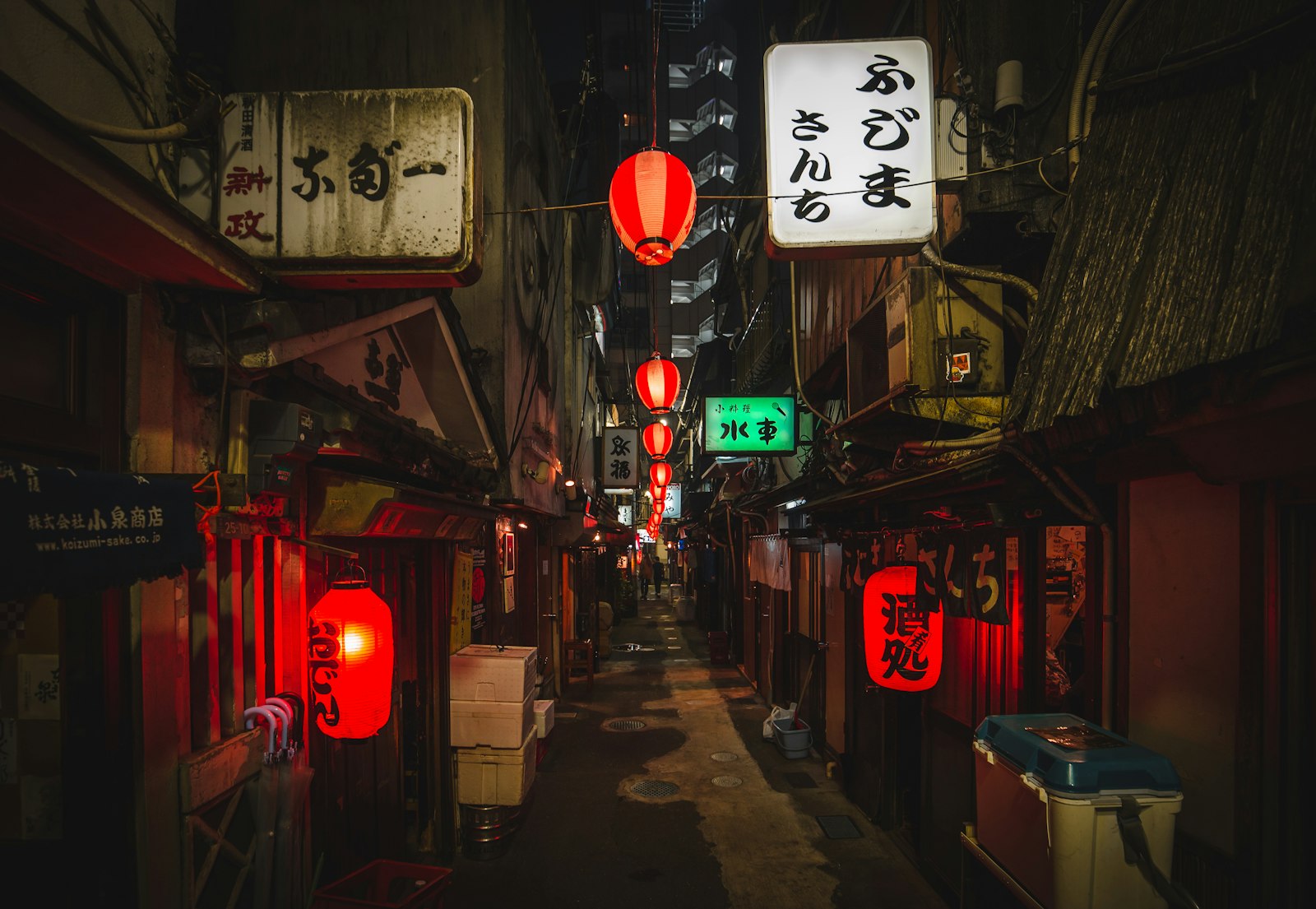
Tokyo is a city you can read by neighbourhood the way you can read a person by their tattoos. Each ward is a register: a vocabulary, a colour, a pace. If you spend a week here looking specifically for how skin is used as design, you can build a small atlas of the city. Below is mine, with a recommendation in each district for what to do, eat, or see in between.
Ginza: Monochrome, Minimal, Behind Doors
Ginza, the old retail spine of Tokyo, is a study in restraint: long blocks of black-stone facades, the fall of evening light off polished glass, a uniform of dark coats and white shirts. Tattooing here, where it exists, is consistent with the rest of Ginza's grammar: monochrome, minimal, hidden, by appointment, often behind an unmarked door upstairs. You will not see a Ginza tattoo from across a room. You might see a thread of black hairline at someone's collarbone in the elevator, and you will not be sure you saw it.
What to do: an evening at a third-floor jazz bar in 6-chome, the kind that has fewer than ten seats and a single record sleeve framed at the entrance. Eat at a kissaten, the pre-war coffee houses still scattered in Yurakucho. Wear: a single fine-line piece on the inside of the wrist, where it will catch the light when you lift the cup.
Harajuku: Colourful, Rebellious, Openly Worn
Walk fifteen minutes northwest and the register changes completely. Harajuku, particularly along Takeshita Street, has been the global headquarters of Japanese youth fashion since the 1990s, and its visible-tattoo culture matches: louder, more colourful, more literal, often visible on the arm or the collarbone of someone in their early twenties carrying three shopping bags. iStock and Getty's Tokyo street archives are full of the typology: bleached hair, platform shoes, bright outerwear, the deliberate refusal of Ginza's dress code (iStock, "Harajuku stock photos").
Tattoos in Harajuku do not whisper. They argue. A small piece is a wave on the wrist with a colour gradient. A bigger piece is a whole composition on the upper arm, designed to be seen across a crowded crepe shop.
What to do: walk Takeshita Street once for the noise, then turn off into Cat Street and find one of the indie clothing shops that have moved up here from Shimokitazawa. Eat: the famous tall, soft-cream crepes, even if you don't really like crepes, because the entire street will be eating them. Wear: a statement, in a place where someone can see it.
Yanaka and Asakusa: The Traditional, Irezumi Heritage
The deepest layer of Tokyo's tattoo culture is in its older eastern districts, where the traditional Japanese style, irezumi, has its heritage. The history is dense. Nippon.com summarises it in a long survey: "tattooing in Japan, known as irezumi, goes back to prehistoric times" (Nippon.com, "Irezumi: The Japanese Tattoo Unveiled," by Yamamoto Yoshimi). Wikipedia gives the more recent crystallisation: it was "in the Edo period (1603–1868) however, that Japanese decorative tattooing began to develop into the advanced art form it is known as today," driven in large part by the woodblock-print culture and the popular illustrated novels of the period (Wikipedia, "Irezumi").
Irezumi is large, layered, traditionally hand-poked using the tebori technique, and historically associated with firefighters, labourers, and (controversially) the Yakuza. It is rarely on display. Public bath houses and many onsen still ban visible tattoos for that reason. But the tradition, the masters who apply it, and the older shops where horishi work, are quietly clustered around the older eastern wards, where the streets are still narrow, the temples are wooden, and the food is served by people in their seventies.
What to do: walk the slow lanes of Yanaka in the morning, before the day-trippers from Asakusa wake up. Visit a small Edo-era cemetery. Eat: shitamachi soba, in a shop that has done one thing for sixty years. Wear: nothing visible. The local register here is respect.
Shimokitazawa: Indie, Illustrative, New Wave
Shimokitazawa, a few stops west on the Odakyu line, is the city's indie creative district: vintage shops, second-floor live-music rooms, vegetarian cafes, the clear sense that a lot of people here are working on something they are not yet ready to talk about. The local tattoo register is illustrative: line drawing, character work, hand-painted feel, sometimes with a single accent of colour. It looks like the artwork on the gig posters in the alley behind the train station, and that is not a coincidence; many of the artists who tattoo here also draw the gig posters.
What to do: Saturday afternoon at a record shop, then dinner at one of the eight-seat counter restaurants. Wear: an illustrative line piece, somewhere visible but not central, like the outside of the bicep or the upper back of the calf. Something that looks drawn, not designed.
What to Wear (Ink-Wise) When You Visit
If you are coming to Tokyo with semi-permanent ink in your travel kit, the best advice is the same as the best clothing advice for visiting Tokyo: pack restraint, then break the rules deliberately.
- For Ginza days: a hairline single piece on a hidden surface. The collarbone. The inner wrist. Black or grey only.
- For Harajuku afternoons: something with colour, larger, on a visible surface. A botanical with one bright accent. A small bird. A short word.
- For Yanaka mornings: cover up. The tradition there is older than your tattoo will ever be. Long sleeves, modest energy, and ideally no visible ink at all in or near temples and shrines.
- For Shimokitazawa nights: an illustrative line piece, drawn-looking, slightly imperfect. The point is to look like you collaborated with the artist, not commissioned them.
The deepest pleasure of a city like Tokyo is that it lets you be several different versions of yourself in a single day. Semi-permanent ink lets your skin do the same.